
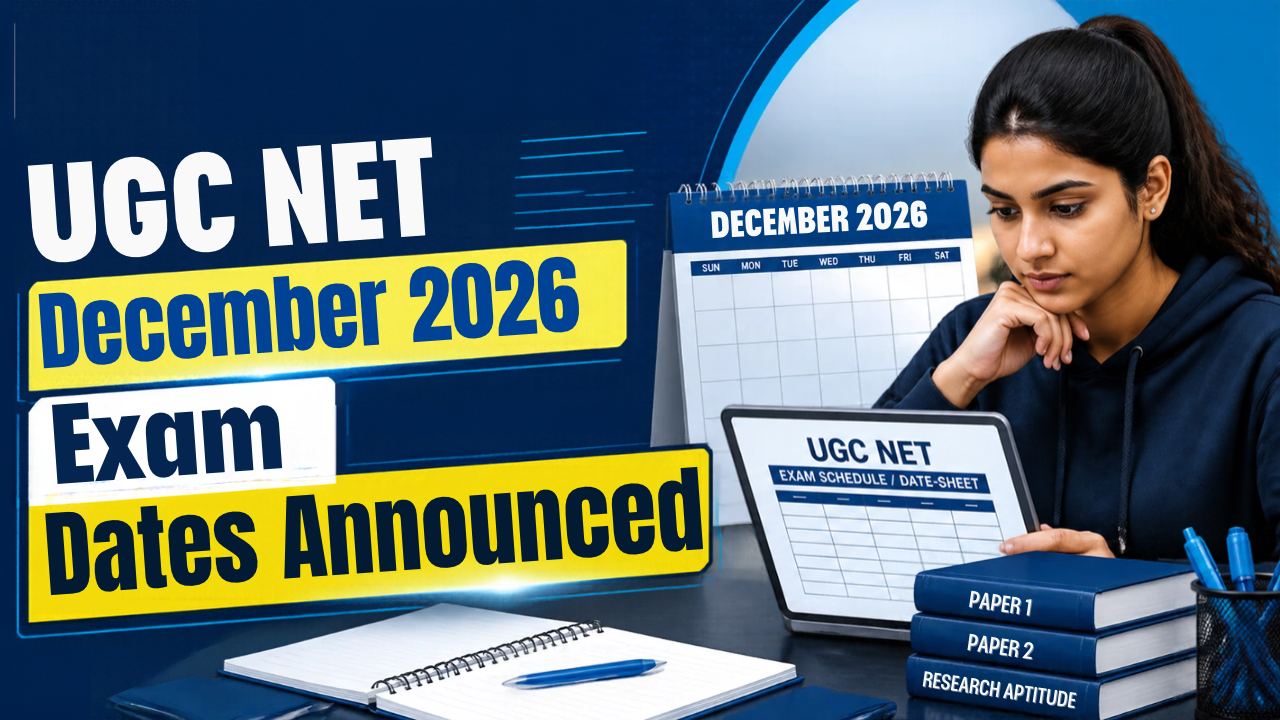
The UGC NET Paper I will be held this year from 14 to 18 December 2026 and 21 December 2026. The examination is officially referred to as the “General Paper on Teaching and Research Aptitude”. It is compulsory for every candidate who wants to appear for the UGC NET 2026 examination, regardless of the subject that is chosen for Paper II.
Paper I will comprise of 50 multiple-choice questions and carry a total of 100 marks. For each correct answer, 2 marks will be awarded. For incorrect answers, there will be no negative marking. Paper I will be conducted in a single session of 180 minutes along with Paper II, in a computer-based test mode. There will be no separate time limit or break between Paper I and Paper II.
UGC NET Paper 1 Preparation 2026: 30-Day Study Plan
Paper I is supposed to evaluate you in:
● Teaching and research aptitude,
● Reasoning ability,
● Reading comprehension,
● Communication skills,
● ICT knowledge,
● Data interpretation,
● Environmental awareness, and
● Understanding of the higher-education system
With a structured 30-day preparation plan, you can find it easier to cover all Paper I units. It will improve your speed, strengthen your weak areas and make you more confident as you sit for regular mock tests.
A 30-day study plan is perfect if you can dedicate around 2-3 hours for Paper I preparation every day. In the final week, you should mainly focus on revision, analysis of mistakes and full-length practice. Here is how to go about the plan.
Day 1: Exam orientation
You have to go through the official syllabus of Paper I, understand the exam pattern, sit for a diagnostic mock test and identify your weak and strong areas.
Days 2–3: Teaching Aptitude
You have to study:
● Teaching concepts,
● Learner characteristics,
● Teaching methods,
● Teaching support systems, and
● Evaluation systems
It is important to prepare concise notes.
Days 4–5: Research Aptitude
You need to cover:
● Types and meaning of research,
● Steps of research,
● Research methods,
● Research ethics,
● ICT in research,
● Referencing styles, and
● Thesis and article writing
Day 6: Comprehension
You need to practice 4 to 6 reading-comprehension passages. It is recommended that you focus on the primary idea, tone, vocabulary in context, inference and conclusions.
Day 7: Communication
It is necessary to study:
● Verbal and non-verbal communication,
● Classroom communication,
● Barriers to effective communication,
● Intercultural communication, and
● Mass media
Days 8–9: Mathematical Reasoning and Aptitude
You are supposed to practice:
● Percentages,
● Ratio and proportion,
● Averages,
● Profit and loss,
● Interest,
● Time and distance,
● Number series,
● Letter series,
● Coding-decoding, and
● Relationships
Days 10–11: Logical Reasoning
In this part, you have to study:
● Structure of arguments,
● Deductive and inductive reasoning,
● Analogies,
● Venn diagrams,
● Indian logic,
● Fallacies, and
● The classical square of opposition
Day 12: Data Interpretation
It is essential to practice questions based on bar graphs, averages, percentages, pie charts, line graphs and tables.
Days 13–14: ICT
You need to cover:
● Computer fundamentals,
● Internet and email,
● Input and output devices,
● Storage,
● Networking,
● Abbreviations,
● Digital initiatives, and
● Cyber security
Day 15: People, Development and Environment
It is necessary to study:
● Sustainable development,
● Pollution,
● Climate change,
● Biodiversity,
● Natural resources,
● Energy,
● Environmental legislation, and
● Development goals
Days 16–17: Higher Education System
You have to cover topics like:
● Evolution of higher education in India,
● Education policies,
● Regulatory bodies,
● Governance,
● Funding,
● Professional education, and
● Value education
Day 18: Revision I
It is necessary to revise Communication, Comprehension, Research Aptitude and Teaching Aptitude. Solve about 50 mixed questions.
Day 19: Revision II
You have to revise Data Interpretation, Logical Reasoning and Mathematical Reasoning. Try to solve about 50 mixed questions.
Day 20: Revision III
You should revise:
● Higher Education System,
● ICT, and
● People Development and Environment
Solve about 50 mixed questions.
Day 21: Full Mock Test 1
Try to sit for a complete Paper I mock test. You have to simulate timed, exam-like conditions. Make unit-wise error analysis.
Days 22–23: Weak-area improvement
Identify the two units from your mock test where you performed the weakest. Revisit them. Solve targeted practice questions.
Day 24: Comprehension and Data Interpretation speed practice
Try attempting data-interpretation sets and timed passages. It will make you more accurate and reduce your answering time per-question.
Day 25: Reasoning and Mathematics practice
Try to solve as many as 60 to 80 mixed questions from:
● Mathematical reasoning,
● Logical reasoning, and
● Data interpretation
Day 26: Full Mock Test 2
Sit for one more full-length Paper I mock test. Once completed, compare your time management skills, attempted questions, accuracy and score with your first mock.
Day 27: Previous-Year Questions
Solve previous years’ Paper I questions, unit-wise. You have to note down common pitfalls, question patterns and recurring concepts.
Day 28: Complete notes revision
You have to revise:
● Formulas,
● Definitions,
● Environment-related facts,
● Short notes,
● ICT initiatives, and
● Higher-education bodies
Day 29: Full Mock Test 3
Sit for a final full-length mock test. After you eliminate clearly incorrect options, try to attempt all 50 questions.
Day 30: Light revision
You should revise your high-yield topics, key facts, formulas and error log. Do not start with any entirely new topic on the last day.
UGC NET Paper 1 Preparation 2026: Important Topics
There are as many as 10 units in Paper I. The official Paper I syllabus includes:
● Teaching Aptitude,
● Research Aptitude,
● Comprehension,
● Communication,
● Mathematical Reasoning and Aptitude,
● Logical Reasoning,
● Data Interpretation,
● ICT,
● People Development and Environment, and
● Higher Education System
When it comes to the important topics, you should pay more attention to:
● Data Interpretation,
● Mathematical Reasoning,
● Logical Reasoning,
● ICT,
● Research Aptitude, and
● Higher Education
It is necessary to focus more on such areas, to ensure effective preparation on your part. Generally, you need to practice in all these areas regularly.
Keep in mind that the official syllabus is designed to evaluate your teaching and research aptitude along with:
● General awareness,
● Divergent thinking,
● Reading comprehension, and
● Reasoning ability
Rather than rote memorisation, you have to follow an application-based learning process.
UGC NET Paper 1 Preparation 2026: Mock Tests
When it comes to preparing for UGC NET Paper I, it is essential to sit for mock tests. Your time management skills as well as conceptual understanding will be tested by this paper. There is no negative marking. After you eliminate obviously incorrect options with care, try to attempt all 50 questions.
Before you start serious preparations, sit for one diagnostic mock test to evaluate your existing level.
Sit for at least 3 full-length Paper 1 mock tests during the 30-day plan. You should preferably do this on Days 21, 26 and 29.
Appear for unit-wise tests after you complete every unit, particularly for Data Interpretation, Logical Reasoning, Mathematical Reasoning, Research Aptitude and ICT.
After every mock test, spend 45 to 60 minutes in analysis. Identify time-consuming questions, misread questions, calculation errors and conceptual mistakes.
Prepare an error log containing the right concept, topic, reason for your mistake and a planned revision date.
Keep in mind that UGC NET is conducted in CBT mode. Naturally, you should practice on a computer-based interface.
To improve, here is how much you should score per mock test:
● First full mock test: Around 60 to 70 marks
● Second mock test: 70 to 80 marks, and
● Final mock test: 80 or more marks
Try to score maximum marks by answering easy and moderate questions. Do not spend too much time on lengthy questions.
Conclusion
You can score highly in your UGC NET Paper I 2026 examination with a systematic and disciplined preparation strategy. You will be able to cover all the units with a 30-day plan. Include regular revision and sit for timed mock tests that can help to improve both your speed and accuracy. With a smart strategy, you can manage to improve your overall UGC NET score significantly.
FAQ
Q1. Is UGC NET Paper 1 compulsory for all candidates?
Yes. Regardless of the subject of choice for Paper II, Paper I is compulsory for all UGC NET candidates.
Q2. How many questions and marks are there in UGC NET Paper 1?
There are 50 compulsory multiple-choice questions in UGC NET Paper 1, carrying 100 marks. You can get two marks for each correct answer. Incorrect answers will invite no negative marking.
Q3. How much time should I give to Paper 1 during the exam?
Both Paper I and Paper II are conducted together in a single session of 180 minutes. There is no separate time limit or break between the papers. You should allocate time according to your strengths and based on how difficult the question level is.
Q4. Which topics are most important for UGC NET Paper 1?
You should focus more on Logical Reasoning, Data Interpretation, Higher Education, ICT, Teaching Aptitude, Research Aptitude and Mathematical Reasoning.
Q5. How many mock tests should I take for UGC NET Paper 1?
Ideally, you should sit for one diagnostic test right at the beginning. Take a minimum of 3 full-length Paper 1 mock tests during the final 10 days of preparation. You should also sit for unit-wise tests after you complete each topic.












Leave a comment